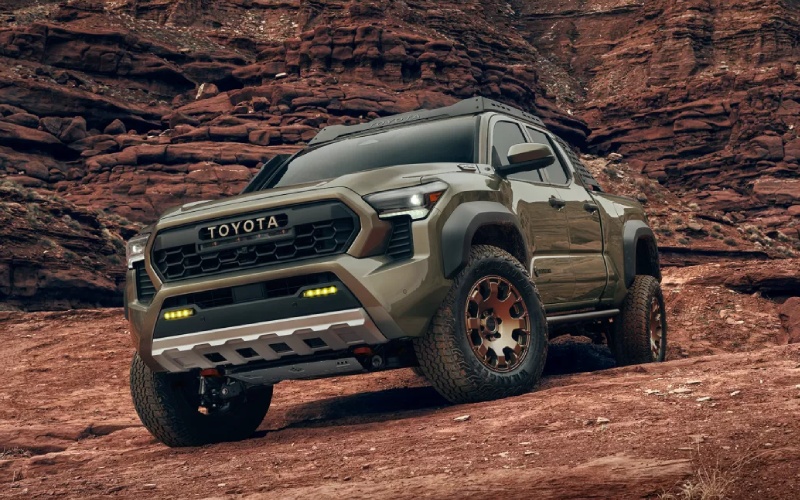
Sebring Toyota - Which midsize truck offers better off-road camera views for Avon Park, FL adventures: the 2026 Toyota Tacoma or 2026 Chevrolet Colorado?
Comparing the off-road camera tech on two popular midsize pickups often comes down to what you can see, how fast you can see it, and how that view integrates with the rest of the truck’s systems. If you are weighing the 2026 Tacoma’s 3D Multi-Terrain Monitor against the Colorado’s available underbody cameras for routes that stretch from neighborhood trailheads to soft-sand service roads near Avon Park, FL, here is a focused guide to help you decide.
Tacoma’s available next-generation 3D Multi-Terrain Monitor (MTM) delivers front, rear, and side perspectives with helpful ground-level views. The system is designed to complement Tacoma’s off-road hardware and drive programming—think Crawl Control (CRAWL), Multi-Terrain Select, and the Stabilizer Disconnect Mechanism (on select trims)—so you are not just watching the trail, you are actively pairing that visibility with traction, throttle, and suspension tools. The integration shows up in the way the available 14-in. Audio Multimedia screen renders crisp, bright video, and how the available 12.3-in. digital cluster can prioritize key off-road info without crowding your sightlines. In short, Tacoma gives you the angles you want and the context you need.
Colorado counters with available underbody camera technology on select trims and packages, including ZR2-focused setups that shine when the terrain gets knobby. The system provides multiple views and can be paired with Colorado’s off-road performance display and drive modes—Off-Road, Terrain, Baja—so you can toggle settings for loose sand, slow-speed rock work, or desert-style pacing. The 11.3-in. center display is quick and useful, and the standard 11-in. digital Driver Information Center is clear for at-a-glance readouts. Where Colorado impresses is in its high-speed composure on rough ground, thanks to Multimatic® DSSV dampers; the camera suite complements that talent well.
So which camera approach gives you the edge for Avon Park outings and nearby runs to the scrub, lakes, or ranch roads? For most drivers, Tacoma’s 3D MTM edges ahead because of how completely it integrates with other off-road systems and how much screen real estate it provides for low-speed precision. If you regularly thread between palmetto roots, tip over eroded berms, or ease into wet boat ramps, the extra clarity and integrated off-road controls matter. And if your off-roading leans more toward higher-speed washboard with occasional ledges, Colorado’s setup still delivers useful visibility with strong chassis control.
- View coverage: Tacoma offers front, rear, and side perspectives in its 3D Multi-Terrain Monitor; Colorado provides multiple camera views, including available underbody vantage points on select trims.
- Screen size and clarity: Tacoma’s available 14-in. display and optional 12.3-in. cluster provide expansive, high-contrast views; Colorado’s 11.3-in. center screen and 11-in. Driver Information Center are sharp and informative.
- System integration: Tacoma’s cameras pair closely with CRAWL, Multi-Terrain Select, and SDM; Colorado integrates with its drive modes and off-road performance display.
- Use cases: Tacoma excels in low-speed, technical terrain and tight maneuvering; Colorado is confident on faster, undulating trails where suspension control is paramount.
For many shoppers, the decision is not purely about the cameras themselves but how those cameras improve confidence in the moment. Tacoma’s camera suite is part of a broader vision that includes Toyota Safety Sense™ 3.0 standard, an available i-FORCE MAX hybrid for instant torque, and optional Trailer Backup Guide with Straight Path Assist for stress-free ramp days. Colorado’s tool set shines when matched with its TurboMax® power and ZR2’s high-travel suspension tuning. Both trucks bring value; the question is where you want your advantage.
If you are looking for a single truck to handle weekday commutes, quick supply runs, and off-grid weekends, Tacoma’s 3D MTM and larger displays make a tangible difference in narrow, brushy corridors and while placing tires precisely over hidden ruts. If your adventures trend toward more open terrain and you are focused on chassis poise at speed, Colorado’s cameras still add helpful context without distracting from the drive. For anyone refining a build—tires, lift, armor—the way Tacoma ties visibility to traction and suspension tools can simplify those choices.
Want a walk-through of both systems on the lot, plus how screen views change with drive modes and camera selection? Stop by Sebring Toyota for a side-by-side demo and a quick tutorial on camera angles and off-road controls. Our team is serving Lake Placid, Avon Park, and Arcadia with test drives tailored to the way you actually drive, whether that means canal roads, ranch gates, or weekend trailheads.
Frequently Asked Questions:
Do both trucks offer underbody camera views?
Yes. Tacoma’s available 3D Multi-Terrain Monitor offers front, side, and low-mounted views for obstacle awareness. Colorado offers available underbody camera views on select trims and packages.
Will the camera systems help at boat ramps?
Absolutely. Tacoma’s wide, bright display and Trailer Backup Guide with Straight Path Assist can reduce backing guesswork and improve visibility. Colorado’s camera views are also useful for situational awareness around docks and curbs.
Is screen size a factor when trails get tight?
It can be. Tacoma’s available 14-in. screen makes spotting small obstacles easier at a glance. Colorado’s 11.3-in. display remains clear and effective, though smaller.
Do the camera systems work with off-road modes?
Yes. Tacoma’s cameras pair with Crawl Control, Multi-Terrain Select, and SDM on select trims. Colorado’s cameras integrate with its off-road performance display and drive modes.